2014年5月20日 星期二

This is what we fight about

There will be no 放屁 jokes here.

The Wind Rises (風立ちぬ) is a Japanese film based on the Japanese short story The Wind has Risen (風立ちぬ) (no, that is not a typo), both of which take their title from the french poem, Le Cimetière marin (The Graveyard by the Sea) which contains the following words at the beginning of the line at the beginning of the final stanza, "Le vent se lève!" (The wind is rising). 

Note: I'm sure there's a good reason why cimetière is not translated cemetery in any translation I can find, but I'm not a french translator, so I can't be sure. And I don't actually think there's a good reason. And mer is sea, so wtf, I mean, really. Can we not just have The cemetery by the sea? Please let there be some colloquial subtlety I don't know about here, or one that mattered in some earlier time.


So, because of this, we get six, yes, count them SIX, translations into the Chinese. Four french words, three/four english words, four japanese characters, and six chinese translations.


Via wikipedia, (go find it yourself you lazy bum, links are silly):


Two official translations:


台灣:風起
香港:風起了


And you thought 瞭 didn't matter. Shouldn't have slept through that day/year of class, I guess.


Unofficialisms:


中新:起風了
澳門:風起了
其它:風雲黃昏,風起之時,風起時

Sayre's Law.


--

And since Hideaki Anno is the lead, I must include his theory on translation, which I've long wanted to post here, but resisted, but which I basically subscribe to whole-heartedly. whole-hog and think about every day.

Twelve-dimensional functionalism:

The meaning of the final scene is obscure,[13][14] and has been controversial.[15][16] According to an episode of the Japanese anime show Anime Yawa aired March 31, 2005 on NHK's satellite TV, Asuka's final line was initially written as "I'd never want to be killed by you of all men, absolutely not!" or "I'll never let you kill me." ("Anta nankani korosareru nowa mappira yo!") but Anno was dissatisfied with Miyamura's renditions of this line.[17] Eventually Anno asked her a question which described what he was going for with this scene:
"Concerning the final line we adopted, I'm not sure whether I should say about it in fact. At last Anno asked me 'Miyamura, just imagine you are sleeping in your bed and a stranger sneaks into your room. He can rape you anytime as you are asleep but he doesn't. Instead, he masturbates looking at you, when you wake up and know what he did to you. What do you think you would say?' I had been thinking he was a strange man, but at that moment I felt disgusting. So I told him that I thought 'Disgusting.' And then he sighed and said, 'I thought as much.'"[18]
Tiffany Grant, Asuka's English dub voice actress, made the following statement:
"The most widely circulated translation of the last line of EoE [End of Evangelion] is "I feel sick," but Amanda Winn Lee (Rei Ayanami's English voice actor and director of End of Evangelion) said she asked several translators, and she felt "disgusting" was the most accurate adaptation.[19]  
http://en.wikipedia.org/wiki/The_End_of_Evangelion

I thought as much. 

2014年3月2日 星期日

Ranking our hatreds

Keeping track of the big insults of the day is kind of a favorite hobby of mine. Occasionally I even write about it. Some of my favorites over the years have the been the 湯唯 incident, the 楊銳之言 and now good old Gary Locke.

http://bigstory.ap.org/article/chinese-media-outlet-uses-racial-slur-us-envoy

http://transliterationisms.blogspot.com/2012/05/blog-post.html

But at the end of the day, how do we really know who is hated most? Lucky you. I've decided to throw my hand in the ring at a very non-exhaustive list of who really is the most hated. Feel free to make up your own lists or contribute your thoughts below. And I know what you're going to say, "What about the Uyghurs or the...etc." I'm sorry. We're trying to keep this first list concise. Maybe you can organize the forgotten hated on your list. Or, maybe, we can only wish, one day there will be a longer updated list that is more inclusive. Enjoy.

10. East asian foreigner who is not Japanese.

You can blend in most of the time, so hatred is kept to a minimum.

9. Non-asian foreigner (we're currently iffy on the question of India, but of course this includes certain sections of "Nepal.")


8. "Asian" foreigner who is not east asian.

7. Japanese people.

6. Foreigner of Chinese origin who does not speak Chinese.

5. Japanese man with a Chinese wife or girlfriend.

Ranked higher than four because there is a chance of passing.

4. Non-asian foreigner with Chinese wife or girlfriend.

3. Chinese citizen who takes positions contrary to the party line.

2. Chinese woman who has a foreign, non-asian spouse or boyfriend.

1. Chinese woman with a Japanese husband or boyfriend. (Including imagined or in movies. See 湯唯)

Bonus 

0. (Intersects with 3 as well.) (Greater) Chinese female 分裂分子 who openly asserts contrary positions from points outside of the motherland. See: 呂秀蓮 and others who will not be named.

--

So, when you think about it, Gary Locke gets off pretty easy. Being a running dog, or "guide dog," whatever that means, is better than being a woman who basically does anything. Or lots of Japanese people.

2013年6月10日 星期一

非非常規引渡

"Hong Kong is the worst place in the world for any person to avoid extradition, with the possible exception of the United Kingdom,” said one lawyer who’s worked on a dozen extradition cases both in the U.K. and Hong Kong, citing a number of murder and drug smuggling cases in which Hong Kong authorities have helped render suspects back to the U.S. While an exception for political cases exists, lawyers said Monday they weren’t aware of any specific instances in which it had been tested.

- Hong Kong Baffled by Snowden’s Hideout

http://blogs.wsj.com/chinarealtime/2013/06/10/hong-kong-baffled-by-snowdens-hideout/

---

Exactly what I was thinking, Hong Kong. Equally baffled.

It’s hard to know what brings the fish scent out so strong that small children must be kept indoors and adults must hold something to their face to survive the smell. Is it possible that a person capable and intelligent enough to be able get the jobs he had and access to the files he released is also ignorant enough to imagine Hong Kong as the shining city on the hill brandishing freedom and democracy, all as sovereign Chinese soil? Or does the fish smell come from any sane person realizing how insane that sounds.

2013年5月19日 星期日

A few of my favorite things

its buying and selling cats and dogs

Yeah, it’s buying and selling cats and dogs.


- - -


I don’t smoke a lot. I smoke about once every 100 years. And I haven’t had my smoke this century yet. When you don’t smoke, you miss stuff like this.


smokers gonna smoke

Look at her face. I know she’s supposed to be covering her mouth, because “SECOND-HAND SMOKE WILL KILL YOUR FAMILY!!” I mean, “Second-hand smoke is a euphemistic way of saying your family hates you and thinks you’re a failure, shithead.” One more try, “Second-hand smoke harms your family, jerk.” FINE, “Second-hand smoke is detrimental to your family’s health.” Are you happy?

The point is, you can and should write anything on there, including sarcastic shit because being all serious and saying, “smoking is no joking!” surely ain’t doing shit. Which takes me back to that photo. The woman there is ostensibly covering her mouth to prevent the smoke monster from harming her or something, but really, you have a look of horror and disgust, as if her husband has been transformed into a smoker, giant bug, horrible monster AND/OR she’s walked in, at her home, with her son in her arms, and discovered her husband in bed, with another woman, not just watching television.

And the kid’s expression does it too. Look at that kid’s face. People look at that face of abject horror EVERY DAY and say, “FUCK IT! GIVE ME MORE EXPENSIVE CANCER STICKS ON THE DOUBLE!!”

Remember kids, never accept second-best. Never settle for “updated blue,” always demand “original blue.”

And, because someone in the government is positive that most people don’t have a heart, they have this on the backside, just to remind them.

for those of you don't have a heart

Department of Health reminder!: you’re a horrible person because you’re a smoker. Quit now, seriously. No one likes you and you’re throwing your money away. Try the lottery instead. At least then you have a chance of winning.

Try 2: Hotline for those looking to quit smoking: 0800 636363, Department of Health, Executive Yuan.

- - -

And obviously, as anyone who writes the for the internet must know, you save the best for last and always bury your lead.

掛power


Because 掛power long ago passed guacamole to become my favorite thing that starts with a 掛. Don’t forget kids, 打拼! Or something.

It pretty much speaks for itself, (i.e., not at all to the uninitiated) but it’s probably better if you soak it in first before knowing too much.

What can I say, I like expressions. And maybe magicians? Or people who do magician 姿勢?

It’s like the drunken brother you had, but never wanted.

- - -

And no series of favorite things is complete without fruit stuck on a tree on a hiking trail. Obviously.

that's a pineapple in case you're wondering

That’s a pineapple, in case you were wondering. And yes, there’s a reason it’s stuck in that tree. And no, I did not put that one (or the other ones!) there.


Have a nice day.

2013年3月25日 星期一

Down-market untranslations

行政院衛生署警告:吃檳榔會引起咀嚼功能障礙及口腔癌

Department of Health warning: Chewing betel nuts causes jaw dysfunction and mouth cancer.

(If it were up to me I’d lead with the cancer, but it’s not.)

cancer balls

cancer up close

Nothing says cancer like a pretty girl with a boob window. Because if you’re going to die of cancer, shouldn’t we try to make your death as pleasant as possible?

-

It’s the little things like this that are just as important as all the ornamental “English” and all the Chinese-in-English/Zhonglish. Once you have one, it introduces a dichotomy that can’t be unseen. What was once just untranslated betel nut warnings, packaging and signage now becomes part of a larger narrative about what “native” means, how marketing creates prestige and how down-market is understood. There then emerges a race to keep up with the Jones’, which almost everyone feels required to play, even if they don’t actually play. The untranslated betel nut packaging company probably “feels” they should have “English” on there, y’know, “just because.”

I’d argue that this is most of what is going on with the personal naming situation, as well, though personal names are complicated by a few other factors: interaction with non-Chinese speakers, comfort with a non-broken romanization system and feelings about one’s nation/culture/history/language (both independent of and in comparison to others.) And probably other important factors I’m forgetting. In Taiwan, I’d say the far-and-away dominant factor affecting the personal naming system is the absence of a familiarity with a non-broken romanization system, but I’d imagine keeping up or un-specific feelings of inferiority (conscious or subconscious) are a strong number two.

-

Now obviously there’s some sort of feedback here. To what extent could chewing betel nuts be made unattractive by showering it in a sea of light and English translations, a la the Taibei MRT stations? Where would smokers run and hide to if they felt their product had somehow been co-opted by hipsters or was clearly marketed to young college age women in the city? Would guys still buy their betel nuts if they all came in pink and purple packages with glitter and doilies? I doubt the MRT ridership demographics would look like they do if the MRT felt more similar to the NYC subway.

So, there you go, I cured cancer, turning lemons into lemonade. You’re welcome.

2013年3月21日 星期四

Convenience store translationomics overdrive

juice

So, what’s going on here?

First, let’s note that “juice” is not written anywhere in Chinese characters, which is another way of saying it is the Chinese. It may be written in roman letters, it may resemble a non-Chinese word you know well, but it is still Chinese.

Since anyone buying this product can immediately identify what it is without reading the word “juice,” what function does that word have there? We could say it’s a high-five and slap on the back of the public for being so hip and learning its ABCs as a kid. That it’s “hip” to use roman letters to show that you “get it” and that you’re with the times and modern and use all the cool new lingo and stuff. That it’s about giving those five year olds a big pat on the head for memorizing all those vocabulary words. Oh, boy, lucky big day, you go to the store and bam! Your favorite company is conspiring with you to produce packaging that makes you feel like you’re learning something and “connected” with the global, modern world and all that shit, with no overt comment about what they think about your actual, current surroundings, or how accurately their labeling resembles actual labeling.

So, we’ve got labeling here that’s clearly not targeted at someone who doesn’t know Chinese (in Chinese characters or roman letters.) But what else do we have? We have programmatic and systematic adding of Chinese in roman letters, which one could imagine is for non Chinese speakers, but is most likely there for Chinese speakers, or really anyone's best guess

This gives us Ponkan.

Ponkan.
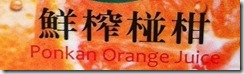
 

ponkan

Could they just as easily have left off the word orange? Yes. Might I find their packaging changed in 6 months to just say “ponkan juice?” Yes.

You remember ponkan, right? It’s 椪柑, pènggān. Who does this matter to?

You know that time in the US when you were really super excited about learning what to call your favorite Kentucky Blue Cheese McBurger sandwich with kale-infused lettuce in Chinese? And then someone was like, “oh, you mean that burger. You can just call it a 漢堡. Your fancy blah blah blah means nothing to me in my language. We barely have the stomach to let people from Kazakhstan use their proper names in Chinese. You think we’re going to let you ramble on about some fucking kind of burger?”

Things about American (North American?) English. 1: Your name counts. You don’t have to be Sally. 2: Your fruit doesn’t count. They’re all oranges. There’s no end to the marketing and classification for things. They can be Michigan cherries or Michigan red cherries or sour currants or whatever anyone cares to call them, backed up by science or not. But it's the people that make the decisions about what things are actually called.

Moving on.

More fruit. Literally.
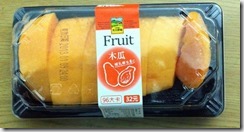
fruit

See those white Chinese characters against a red background? They say 木瓜. At least where I come from, 木瓜 usually means papaya. You're probably thinking, "they've put a picture, right? That's good enough. All fruits TOTALLY have distinctive shapes! No one ever confuses one spherical fruit with another, especially when it’s without any colors! That’s crazy!”

So, actual thing needing to be labeled, yet the result is the worse than nothing “fruit.” Again, what we have here is a nice pat on the head for 育良: look at you superstar! A totally bat-shit crazy labeling of a product you can totally see and buy has a word you fucking know and can pronounce, maybe! And it’s all fucking English! You’re the king of the world!

So, story here, again, is we have Chinese written in roman letters, for a Chinese speaking audience. Do you see a pattern? This might be getting boring for you. Sorry.

Moving on.

How about a delicious sandwich?

I know what you’re thinking: the “delicious x” is an incredibly rare structure and hard to use properly in English, so surely you’re not going to show me some packaging with that written on it that also tells me to start referring to everything as “tasty,” as well, are you?

Settle down there, cowboy. It’s just a delicious sandwich.


delicious sandwich

Doesn't it just look delicious?

The best thing about this is that along with our “fruit” example above, there’s not even a pretend attempt to inform through the use of roman letters here. We’ve abandoned all pretense to use roman letters in a way that might not cause an English speaker to sneer (remember, it’s tough to criticize single words composed of roman letters that stand alone, are fully formed and are spelled correctly.) Here, delicious sandwich cannot be read as anything except 好吃的三明治, and that’s of course why you will not find any of that written anywhere on the labeling. Sure, there’s a 土司 here and there, but that’s about it.

Why do I find this interesting? Because it’s a weird kind of thing. It’s not like pig latin, where you kind of shift things a bit to the left or look at them a little funny till they make sense. It’s not like when Ataturk made everyone stop writing in the Perso-Arabic script either. And it’s not really like India where people kind of just switched to English, or used it as a different language. Here we have a kind of consumption of the skeleton of the language: it’s sounds and writing system, and also a lot of the basic mappings of a lot of the words to certain meanings. And after chewing up all these skeleton bits, it’s wrapped around the same culture and people as the old language, with it’s old ways of saying things and writing things and meanings that make sense to them.

Delicious sandwich isn’t English. It’s Chinese, written in roman letters, pronounced according to a phonetic rule system everyone learns as a kid, based on the meanings and mappings that are common and make sense to Chinese speakers, and are foreign (and often incoherent) to places where English is spoken as a native language.This is Chinese, it’s just got a new wrapper, and a new script that looks nearly identical to English and with new sounds that sounds that are nearly identical to English, and a grammar that picks and chooses parts of English grammar to hold fast to when it wants. I think it’s wrong to call this Chinese English, which should really be reserved for something like American English or British English or Indian English. I think the term Chinglish is best applied to a compromise of an attempt to communicate across languages, something closer to a pidgin or a creole. This distinction is subtle, but “Delicious sandwich” on labeling for native English speakers is Chinglish, but on labeling for Chinese speakers, I think it’s 英式中文, or Engwen. (But since that’s kind of a fail as either Yingwen or Engwen, I guess Zhonglish is where we end up.) Some see the distinction between instrumental vs. ornamental, but I think that’s beside the point. Zhonglish is sometimes ornamental, but it doesn’t have to be. Sometimes it is instrumental and ornamental. And sometimes it is purely instrumental.

The question is, why? If you’ve got a perfectly good system to do all these things, why adopt a new one? One could argue it’s just a fashion thing: “English” today, “Hungarian” tomorrow, etc. Or one could argue it has to do with deeper power dynamics. I think you know where my vote is.

Moving on. Let’s move over to the magazine rack.

magazines

Whatcha reading guys?

Oh, the new issue of ELLL?  I LLLove that magazine! Or should I say I 心心心 that magazine?

What about you? COOKing? I fuck營 love suffixes that can be used to make gerunds too! Let’s be friends and be confused about verbs and how to translate 烹調 together!

The great thing about this shot is that everyone looks like they're reading "English," as if reading magazines in not-English is something only hooligans would do who just come into 7-11 to buy cigarettes, which IS TOTALLY NOT THE BREAD AND BUTTER OF THEIR OPERATION! DO NOT THINK THAT EVER! THEY SELL CUTE ANIMALS AND YOGURT DRINKS, NOT CANCER STICKS THAT WILL SHORTEN YOUR LIFE AND KILL YOUR RELATIVES WHILE SUCKING AWAY YOUR MONEY AND WILL TO LIVE!

Anyway, it’s the same thing going on here in the shot as in above. Just read that part over if you still don’t get it.

2013年3月10日 星期日

Drugs and Sex

A lot of people wonder what happened to all the old sites of the web. It seems you almost never find something from the early days anymore. There’s a good reason for that and it’s only partly because no one links to or reads old stuff. That good reason is that most of the early web was porn. And you can’t find it because those sites are all gone. Where you can find it, however, is in books, (yes, dead-tree books) that people wrote around that time and which serve as the only decent records of what happened back then. And since I mostly talk about pop music or other silly things here, instead of what’s really dominant on the internet (porn,) think of this as a corrective to that overlooking. But first, some fun with drugs since sex and drugs seem to go together like peas and carrots.

Note: More 7-11 fun is still in store. (Pun intended)


Drugs:


drugs mean never having to say youre sorry

A happy life is a drug-free life.

Love begins at the rejection of drugs. (And judging by the location of this wall, drugs apparently start in Banqiao.)


Sex:

情色男女網路站

編著: 章道安 朱怡陶

Pornographic web sites

Editors: Zhāng Dàoān, Zhū Yítáo

p.47

Tokyo Topless

http://www.bekkoame.or.jp/~adolf/web/home.html

Last Update: Aug 28, 1996

Headlines

歡迎來到日本的熱血王牌站台,肉體橫陳,美女如排山倒海般向你撲來,高血壓及心髒病患者要預防發生意外。血壓方剛的青年,更不要忘了先拿棉花把鼻孔塞好,以免到時候...。

Welcome to Japan's hottest web site. Here you'll find enough skin and beauties at your service to kill a small horse. However, friend, beware: this page is not for the faint of heart. Those with high blood pressure or heart disease should take the necessary precautions to ensure their personal safety. For those of you just reaching manhood, don't forget to stick some tissues up your nose. It can help to avoid problems that may arise in the near future, if you catch my drift.

---

And because we cover language here, here’s one of the many hidden treasures from this book:

p.140

性愛英語

大公開

任何一種語言最難精通的部份就是俚語了,但是往往在學會以後便成為您日常生活中最常用、也是最有用的部份。以下的每一個字彙可說是字字珠璣,絕對需要您去熟讀背誦、反覆練習,才能達到爐火純青的地步。英文是國際語言,一旦練就一身好本領,您馬上就可以在成人站台裡上山下海,有如神龍活現般的悠遊其中。在您看完了各國紅燈區旅遊資訊之後,是否有立刻出國一遊的衝動?只要帶著這套字彙,再也不會有各國美女當前,而只有能膛目結舌、不知所云的悲慘狀況發生,這時宣揚國威的重責大任就拜託您了。

Sexual Terminology in English

Everything you need to know.

The toughest part of any language is surely its slang. But it often happens that this part of the language is what you come to use more than anything else day to day. And it's this part of the language that often is the most useful. Each term below can be thought of as a precious jewel. Take time to memorize each and every one. Only through repetition and practice can you attain perfection in their usage.  English is an international language. Your mastery of its particulars are a skill you can carry with you for all your days. But, first and foremost, you can use them to swim in vast sea of adult sites to your heart's content. After reading about each country's red light district, you're probably feeling the sudden urge to pay each one a visit, right? With this trusty phrasebook at your side you won't ever be stuck with a beautiful foreign lady at your side, completely unable to communicate. Nothing less than the prestige of our nation demands that you get these words right. Good luck.

2013年2月13日 星期三

2012年12月12日 星期三

Taiwan and China: Two cultures separated by a common language

Huang Guanhua - 黃冠華

http://money.chinatimes.com/news/news-content.aspx?id=20121104000829

- Want to do business in China? First think about the world.

The word in recent years out of the Taiwanese media almost always seems to assume that Taiwan is going to become the so-called "springboard" for the world's large corporations to enter China. The thinking is these business want to enter China, and Taiwan is where they can come to test the waters before they do. If all goes without a hitch, they can take what they've learned in Taiwan and start talking real money in China.

I'm not sure this is particularly enlightened thinking.

My company does personnel evaluations at the end of each year. Everyone ranks all their coworkers, with no exceptions.

Our staff includes people from over ten countries. The evaluations can be completed in Mandarin or English, but the questions are the same. In addition to evaluating those around you, you also have to evaluate yourself.

The biggest reason to have self-evaluations is for people to see if their personal evaluations match up to how others perceive them. It's basically to cut down on people having wildly out-of-sync thoughts about themselves. If you know about your own weaknesses you'll be less likely to make gross errors of judgement from your ignorance.

- Chinese people think they're great, Taiwanese people think they might kinda be doing ok

With executives from Taiwan, China and the US, which two groups do you think would share the most values? I suppose most people would assume this is a silly question, one hardly worth even asking. Of course, Chinese and Taiwanese people are going to be the most similar, right? They've got a common language and both come from the same stock. Americans, on other hand, have a completely different culture, foreign to both China and Taiwan.

Well, this didn't exactly turn out to be the case.

The Americans, (and most of the other staff who weren't from China or Taiwan) who operate in a culture that is constantly stressing self-confidence, predictably rated themselves extremely well in their evaluations. They were similarly confident they made important contributions to the business. If we were to use grades, nearly all of them gave themselves A's. Translating this to bonuses, they clearly expected nothing but the most generous packages.

The Taiwanese, on the other hand, were nothing if not your typical Taiwanese: traditional, humble, and low-key. Most gave themselves a B or a B+. Even the best managers rated themselves this way.

So what about the Chinese? Owing to their gigantic market and rabid competition, the Chinese managers ended up with the same levels of confidence as the Americans. Every single one gave themselves an A or an A+.

- Fight 'em in the streets, fight 'em in the jungle

So at their core, the Americans and Chinese turned out to be the most alike. It was as if the Taiwanese were from a completely foreign culture with its own distinct ways of thinking and acting.

With this in mind, does it make sense for anyone to use their experience in Taiwan to start to do business in China? Are Taiwan's potatoes simply too small to be relevant for the giant markets of China and the US? In China and the US, you've got classic guerilla warfare. The competition between businesses is just as fierce as it is between people looking for work. People are spread out everywhere and the battlelines stretch on for miles. Strategy, tactics and positioning are all like nothing we have in Taiwan. The keys to success in this kind of fighting are your ability to adapt appropriately and think about the bigger picture.

Taiwan, on the other hand, is basically a niche market. Instead of fighting it out in the jungles, we're throwing punches in the streets. We're like a cop movie where you know the crime is going to be solved by the end of the film. Every quick turn, attack or block assumes an enormous weight as it might prove crucial to how the story ends. As a business In Taiwan, you might be sitting pretty in Taipei and be able to earn a pretty penny that way. But everyone knows once you leave the city limits you must as well be facing a different planet. In comparison, you have the situation multiplied by a million in China. There you have to think about every city and every province. You've got to think about the different regions and everything else in between.

- Original recipe vs. catering to the locals

I know you're thinking, "What about all those businesspeople from Taiwan who already went to China and were successful?" If we look hard at the big and successful business in China run by Taiwanese businesspeople, like Want Want and Ting Hsin, we see that they don't resemble anything we have in Taiwan. Calling these Taiwanese businesses means nothing more than the owners were born in Taiwan or that some of the senior and technical staff come from Taiwan.

The idea of replicating a successful business experience from Taiwan in China is just something I've never seen or heard of. Keep in mind that this applies mostly to operations and strategy. With their dedication and professionalism, Taiwanese people are sure to be your greatest asset, wherever they are. That's what you should keep in mind, not the idea of simple and clean replication.

- Island culture and Continentalism

So, what have we learned? Success in Taiwan in no way guarantees easy success in China. I can think of almost nothing but examples of people who tried to copy what they did in Taiwan in China and failed. Horribly.

After decades of separation, a common language and common past doesn't mean much. We just don't think the same way anymore. We've got that much-discussed "island culture," round here and they just don't have it there.

For us, the way we think about China needs to be the way we think about the US. But, of course, that will require a certain amout of rebooting as well. We still have tons of Taiwanese people who go to America and treat it like a magical land where they're barely fit to shine people's shoes. And when they step foot in China they feel ten feet tall. They set up shop in China in their own little insular communities and barely speak a word to anyone else, whether it be in their business or personal lives. If we see more failures over there don't say I never said how to stop it.

2012年11月3日 星期六

Unrecoverable Partitions?

The name Shih Tzu comes from the Chinese word for "lion" because this kind of dog was bred to resemble "the lion as depicted in traditional oriental art,"[1] such as the Chinese guardian lions. (There is also the Pekingese breed, called "lion dog" in Chinese). "Shih Tzu" is the Wade-Giles romanization the Chinese characters 獅子, meaning lion; Wade-Giles romanization was in use when the breed was first introduced in America, but in modern times Pinyin romanization is used, rendering it shīzi. The Mandarin Chinese pronunciation is approximately shirr-tsə. The Shih Tzu is also known as the "Xi Shi dog" (西施犬) because Xi Shi was regarded as one of the most beautiful women of ancient China.[2] Shih Tzus were nicknamed the Chrysanthemum Dog in England in the 1930s.[3] The dog may also be called the Tibetan Lion Dog, but whether or not the breed should be referred to as a "Tibetan" or "Chinese" breed is a source of argument, the absolute answer to which "may never be known".[4]

http://en.wikipedia.org/wiki/Shih_Tzu

- - -

其实粤语发音中“文”也是以“m”为声母的,而不是“w”。
音译的东西其实怎么好听怎么来
像外国人起中国名字也是只取其谐音即可,重要的是找个中国姓并富有含义,如汤若望(John Adam Schall von Bell)、南怀仁(Ferdinandus Verbiest)等
早期传入中国的外国词,都往往比较东方化(或中国化),像“美国”、“英国”、“德国”、法国等,后来外国的东西多了,像马达加斯加、马来西亚、马耳他、马其顿等不能都叫“马国”吧,所以音译的就多了。
但至于为什么偏要翻译成“明治”、不翻译成“明智”、“明志”或“三威治”等,是否和当初翻译的人崇拜“明治维新”有关有待考证。
不过话说回来,普通话音译的那些地名、人名确实很不怎么样。

http://tieba.baidu.com/p/199363895

確實很不怎麼樣

I think length is a crucial element as well. Coffee?

Guess I’ll leave en.wikipedia.org/wiki/Kung_fu_(term) for another day.

2012年11月2日 星期五

Actual English names for Open小將 and friends: Part 1


Open小將

the wand of death

Supposed English name: Open-chan.

When's the last time you met someone named Open-chan? Sounds like a fake name to me.

Actual English name: The Colonel.

That’s not a magic wand, it’s a wand of death. And put on some clothes, pervert.

Don’t you find it a little curious that Open小將 has no shadow?


Lock小醬

bLOCKhead

Supposed English name: Lock-chan.

Give me a break. And I suppose we’re supposed to call the Minister of darkness “Fred” if he asks politely enough?

Actual English name: Colonel Mustard.

If 小醬 and 小將 are really arch-enemies, why do their names sound exactly alike? Why are you able to to get a picture of one by merely changing the amount of light and putting on or taking off a giant mustard stain on his hat?

But in all seriousness, if I was a kid I wouldn’t be able to draw a more frightening naked space dog cartoon character if I tried.

Favorite Lock小醬 quote: “Every normal man must be tempted at times to spit on his hands, hoist the black flag, and begin to slit throats.”

And that's what he sounds like when he's having a good day.


Please美眉

heart of darkness

(Side-note: It took way too long to find a picture of Please美眉 where she is just standing there waiting to give you a hug and not bending over. You will find a picture of a swastika, after lots and lots of porn, before you find one. General pro-tip: do not try searching for pics of 美眉 in Google.)

Supposed English name: Please-chan

Please美眉 (no space!) is known by her friends as Pretty Please.

This is where I type something in and not make a comment about it:

Special Skill: “I love trying cosplay.”

Don’t worry, it’s not promoting antiquated gender roles or the hyper-sexualization of young girls (or worse) because her birthday is 2/14 of year not given. And everyone knows all guys love pink and purple. And, coincidentally, based on rigorous internet research, immortally young girls.

Actual English name: Colonel Kurtz, a.k.a The Heart of Darkness

Please美眉 has the power to use the phrase tee-hee three times in only two sentences. In other languages this dark art translates to her ability to type in the heart symbol (in addition to other symbols) in lieu of actual Chinese characters. Or, to put a positive spin on this, it may just point to some degree of illiteracy.

Select quotes come from here: www.open-chan.com/

Part 2 coming in the future because the past is hard to to get to.

2012年10月15日 星期一

2012年8月8日 星期三

想想台灣 Thinking Taiwan

蔡英文 – Tsai Ing-wen (Cài Yīngwén)

原文: http://www.thinkingtaiwan.com/public/welcome/site_info

With the presidential race over, many have asked what I plan to do next. For them I always have but one answer: think hard about Taiwan. Most respond to this with more than a little curiosity and skepticism. What exactly, they ask, is thinking hard about Taiwan?

Walking along the street one day, I saw a young motorist stopped at a red light reach down from their motorcycle, pick up an empty plastic bottle and put it in a nearby trash can, all done without a second thought. The whole incident couldn’t have lasted more than a few seconds, but I was completely moved. Rest assured, this wasn’t the first time they had done something like this. It was clearly the type of action they had built into their life. And it’s the little things like this, added up, that make Taiwan just a little bit more pleasant. That person probably wasn’t thinking about very much when they picked up that bottle, but from my point of view, they were doing precisely what I call thinking about Taiwan.

Another time, I was watching television and saw a young sports fan that went around to events in full Techno Prince Nezha (電音三太子)gear with a Taiwanese flag draped across his back to show his support. He wanted to remind everyone that there’s wonderful country they might not know about called The Republic of China, which they may know as Taiwan. Some might say this type of thing can’t really compete with an official government campaign, but if you ask me, that young fan was thinking about Taiwan.

I’m also acquainted with a few seniors who, despite being retired, are still interested in doing something for their country. They’ve taken up as their cause some less privileged students who leave school every day without any family to walk with them, arriving at a home without so much as a desk they can use for their homework. These seniors work hard to find the resources and people that could make a difference in the lives of these children as they grow up. All across the far-flung and remote areas of Taiwan they’ve set up after-school centers to give these kids a place to go; a place where they’ll see that since this country hasn’t given up on them, they aren’t allowed to give up on themselves either.

These dedicated seniors are what I mean by thinking about Taiwan.

Speaking from experience, thinking about Taiwan actually feels great. Our politics, however, full of distractions on one side and a sense of helplessness on the other, has mutated this simple act into something dark and needlessly complex. Thinking implies more than a yearning. Thinking about Taiwan means putting our country at the front and center of your mind. With Taiwan on your mind you can begin to consider and tackle our country’s most pressing needs. And this thinking needs to be covering not only the broadest scope, but also exploring the depths of our problems as thoroughly as possible. In the past, we believed the government would always find a way to help us with this thinking, but in recent years we’ve seen with our own eyes that this faith was perhaps ill-founded.

If no one will come to help us think, we must begin to think for ourselves. We must roll up our sleeves and come to our own conclusions. This is what I call thinking about Taiwan.

It is a mystery to no one that Taiwan is a country with no shortage of problems. Domestically, the issues deserving of our immediate attention are myriad. With our present set of economic troubles, our top priority is discovering what new models will fuel our future development. At the same time, we must never shirk our duty to ensure our equal and just society co-exists alongside this growth, without getting in its way.

Our democratic framework is too not without its flaws. The never-ending partisan rivalry has created a situation whereby consensus-based solutions are never arrived at. To make matters worse, the final, unprejudiced arbitrator of our government, the judicial system, similarly fails in their goal of inspiring public confidence. Our democracy is like a jigsaw puzzle missing a crucial piece. People talk past each other, holding fast only to their own beliefs. The result is that our communal sense of trust deteriorates just a little more each and every day. If we continue along this path, it will surely be the end of us.

In the future, our relationship with China is obviously something we will also have to think hard about. Many have the distinct impression that China is a place full of unknowns. They also believe China believes in nothing if not the rejection of our sovereignty. At the same time as we, with no illusions, see ourselves increasingly dependent on China, we must also think hard about our long-term strategy of dealing with China. To do this we must better understand China itself. We must free ourselves from the constraints of the narrow framework established in past discussions of Cross-Strait Relations. We must see the problem with fresh eyes and with new ideas informing our understanding. We must see how the rest of the world sees China and how China sees the rest of the world, including us. Finally, we must deepen our understanding of both the people and the government of China, while not neglecting the many businesses operating in China founded by our fellow citizens.

As a separate issue, we must think hard about Taiwan’s place in the world and how changes in the international community will come to affect Taiwan. From the European debt crisis and the 2008 financial crisis, to the American presidential election, China’s economic slowdown, a recession among the BRIC countries and the Arab Spring, these events all around the world have a unique meaning for Taiwan. It is our duty to think hard about what that meaning is.

And of course, we have our own social welfare issues to think hard about. Our social safety net as it stands now is incomplete. Those at the margins of our society lack the care and dignity they deserve. Looking forward, if our systems are not rigorously and carefully planned out, if we don’t determine the best policies and programs, our nation’s finances will be depleted without delivering services with a level of quality we can all stand behind. At the same time, we must learn how best to empower the greater society in this plan, harnessing our communities as an additional branch of government to work with us on issues such as health care, social services, employment and business within a united framework.

Last, but not least, we must think hard about our culture. What exactly do we create? What is it that makes Taiwan special?

When I tell people about the online forum I’ve started, I’m usually urged to think twice. I’m told that with information everywhere around us, no one’s looking to get flooded with even more information. Then people insist that things online have to be fun and relaxing, otherwise they face certain death. Believe me, this is nothing I haven’t heard before. And despite this, I’m optimistic. I’ve always believed that there’s a real yearning for rational discussion in Taiwan. I believe that between all the gossiping and joking around online there’s still plenty of space waiting to be found by us.

This space is for our thoughts. It is for our hopes and dreams. Thinking Taiwan isn’t just an online forum, I want it to become a movement: a movement built on welcoming, strong, serious and critical thinking.

To start a serious online discussion forum in this day and age may be naïve, but I’m willing to give it a try for my country. How long has it been since you’ve thought hard about Taiwan? Come on in and share your ideas. Let’s think about Taiwan together.

2012年6月10日 星期日

And the racism. The Untranslatables: Plastic Cups edition, volume fin

黑人為什麽喜歡吃白巧克力?

答案:怕咬到手指頭

Believe me, there’s no typo on my end.

--

Why is this edition: fin? Well, a long time ago I had to stop reading Language Log because it turned into Mark Liberman posting every day, “OMG! Did you see this totally unimportant thing in the newspaper where the word order made a funny?” or “OMG, Dinosaur comics did this thing with the language and omg!” That kind of stuff seemed to leak onto other writers (in addition to dominating the site) and it put me in such a bad mood that I cut it out of my diet.

So, to avoid doing stuff I don’t like, we go out today with a bang. And believe me, you’ll want that after reading this doozy, (assuming you’re still alive after racist McTypo above:

綠豆是哪裡人?

嘉義人。。。因為綠豆加薏仁

If you are fighting back the desire to jump off a building after reading that, I’m sorry. I really am.

2012年6月9日 星期六

The Untranslatables: Plastic Cups edition, volume 2

男賓止步 (猜一字)?

A: 嫗

--


--

Luckily, I brought a portable crash cart with me.

2012年6月8日 星期五

Crisis on Infinite Earths, Clash of Civilizations

美臀: Fine ass

stay classy, san diego

http://twimg.edgesuite.net//images/twapple/640pix/20120609/BN05/BN05_005.jpg

http://www.youtube.com/watch?v=Ubgx8WH84jw

Some say the best part of cultural differences is the food, but I’m pretty sure it’s the sexism.

2012年6月7日 星期四

The Untranslatables: Plastic Cups edition

第十一本書 (猜一句成語)?

答案:BOOK 11 (不可思議)

---

Absolute zero cold. Every time I run across one of these my heart literally stops dead in its tracks from the body blow that are these “jokes.”

I’m not quite decided on why they’re untranslatable. Is it because they’re so bad that translating them poses a health risk to the reader? To the translator? Is it possible that in translating them they would dissolve into nothing? Something like this,

English: Why did the chicken cross the road?

Why?

To get to the other side.

中:


or

中: 為...雞為... ... 靠.

算了。

The closest I can think of is this, where the really great jokes start at 4:15.

http://www.youtube.com/watch?v=Dyc8j-LxzLU

“Four-hundred and eight over rice.”

In the clip we do get a kids “Superman” joke, which is close to some of the stuff that slays me, and I’ll certainly get it up here if my heart is able to restart itself after reading it next time.

I remember reading some “joke” books when I was a kid where all the “jokes” would be these one line puns that almost tried to NOT be funny. I remember thinking, “that’s not a joke, that’s just two things that rhyme. Why is this in a book? This isn’t anything!” I was about 10.

2012年5月29日 星期二

公安部要清掃洋垃圾:抓洋流氓,保護無知少女,五道口和三裡屯是重災區;斬首洋蛇頭,美歐失業者來中國圈錢,販賣人口,妖言惑眾鼓勵移民;識別洋間諜,找個中國女人同居,職業是搜集情報,以遊客為名義為日本韓國和美歐測繪地圖,完善GPS;趕走洋潑婦,關閉半島電視台駐京辦,讓妖魔化中國的閉嘴滾蛋。

- 楊銳

(5, by the way.)

Translation:

洋洋洋洋洋洋洋洋洋:洋洋洋洋,洋洋洋洋洋洋,洋洋洋洋洋洋洋洋洋洋洋;洋洋洋洋洋,洋洋洋洋洋洋洋洋洋洋,洋洋洋洋,洋洋洋洋洋洋洋洋;洋洋洋洋洋,洋洋洋洋洋洋洋洋,洋洋洋洋洋洋洋,洋洋洋洋洋洋洋洋洋洋洋洋洋洋洋洋洋洋,洋洋洋洋,洋洋洋洋洋,洋洋洋洋洋洋洋洋洋洋,洋洋洋洋洋洋洋洋洋洋洋。

(5, by the way.)

For those not a fan of the magnificent 楊銳 translation machine, here’s a less literal translation:

Fucking “foreigners,” fucking “foreigners,” fucking “foreigners,” something offensive about women, fucking “foreigners,” fucking “foreigners,” GPS, fucking “foreigners,” another offensive thing about women, fucking “foreigners” and fucking “foreigners.”

-

When they finally do come for you it will be with a suit and a tie, not a gun and a uniform.

2012年5月21日 星期一

Properly translating the important parts of politics

很奇怪耶你!

1.What the fuck!

2. What’s wrong with you?

3. You’ve got to be kidding me.

4. You’re unbelievable.

2012年4月14日 星期六

Literal Translation and Dead Translation

Recently, no small number of individuals have been attacking the idea of literal translation. They don’t claim that literal translations are actually incomprehensible; instead, they say that the translations are merely difficult to get through. Even if we grant that literal translations are more difficult to get through than other types of translation, they certainly aren’t impossible to understand. There’s a word for translations that are actually incomprehensible and it’s not literal translation; it’s dead translation.

Roughly speaking, literal translation is writing that doesn’t recklessly differ from the original. More specifically, it means translation that attempts to maintain the tone and style of the original. Aside from the negative admonition against reckless adaptation, the positive implication of that first definition above is that care must be taken with regards to sentences as a whole. Words in Western languages can differ greatly between actual usage and their dictionary definitions. The meaning of a word can change based on conditions, while a dictionary would merely note its basic meaning. Dictionaries are incapable of noting all these conditions-based changes. Because of this, appropriate translations must be made based on the meaning of a word in its context. Inserting a dictionary definition in your translation instead, is simply dead translating. While a word chosen this way won’t recklessly differ from a dictionary definition, it will not match the source text. Even if we stop looking at the question of a translated word matching the source text, dead translations still aren’t very good. With dead translation the words still find themselves lacking proper arrangement. And it is this kind of translation that is truly incomprehensible. For less discerning readers, these dead translations are perceived to be failed literal translations. That criticism, however, is wholly without merit. The basis of literal translation is solid. It is translators, originally seeking to produce literal translations, but ultimately failing, and producing dead translations, who are to blame for this common occurrence. The only other explanation is that some imagine literal translation to be some trivial task and don’t take their work very seriously, producing the kind of work that leaves readers scratching their heads. There are no positive steps to be taken at this point to solve the problem; the best we can do is call for translators to stop taking the task of literal translation so lightly.

“直譯”與“死譯”

茅盾 -《小說月報》第13卷第8期

1922年8月

死譯 could have just as easily been 笨譯 or 蠢譯. I think “dumb” translation is maybe a better term in English in any of the cases. “book” translation would be good if it didn’t imply the translation of actual books. Maybe “rule” translation.