2013年5月19日星期日

A few of my favorite things

its buying and selling cats and dogs

Yeah, it’s buying and selling cats and dogs.


- - -


I don’t smoke a lot. I smoke about once every 100 years. And I haven’t had my smoke this century yet. When you don’t smoke, you miss stuff like this.


smokers gonna smoke

Look at her face. I know she’s supposed to be covering her mouth, because “SECOND-HAND SMOKE WILL KILL YOUR FAMILY!!” I mean, “Second-hand smoke is a euphemistic way of saying your family hates you and thinks you’re a failure, shithead.” One more try, “Second-hand smoke harms your family, jerk.” FINE, “Second-hand smoke is detrimental to your family’s health.” Are you happy?

The point is, you can and should write anything on there, including sarcastic shit because being all serious and saying, “smoking is no joking!” surely ain’t doing shit. Which takes me back to that photo. The woman there is ostensibly covering her mouth to prevent the smoke monster from harming her or something, but really, you have a look of horror and disgust, as if her husband has been transformed into a smoker, giant bug, horrible monster AND/OR she’s walked in, at her home, with her son in her arms, and discovered her husband in bed, with another woman, not just watching television.

And the kid’s expression does it too. Look at that kid’s face. People look at that face of abject horror EVERY DAY and say, “FUCK IT! GIVE ME MORE EXPENSIVE CANCER STICKS ON THE DOUBLE!!”

Remember kids, never accept second-best. Never settle for “updated blue,” always demand “original blue.”

And, because someone in the government is positive that most people don’t have a heart, they have this on the backside, just to remind them.

for those of you don't have a heart

Department of Health reminder!: you’re a horrible person because you’re a smoker. Quit now, seriously. No one likes you and you’re throwing your money away. Try the lottery instead. At least then you have a chance of winning.

Try 2: Hotline for those looking to quit smoking: 0800 636363, Department of Health, Executive Yuan.

- - -

And obviously, as anyone who writes the for the internet must know, you save the best for last and always bury your lead.

掛power


Because 掛power long ago passed guacamole to become my favorite thing that starts with a 掛. Don’t forget kids, 打拼! Or something.

It pretty much speaks for itself, (i.e., not at all to the uninitiated) but it’s probably better if you soak it in first before knowing too much.

What can I say, I like expressions. And maybe magicians? Or people who do magician 姿勢?

It’s like the drunken brother you had, but never wanted.

- - -

And no series of favorite things is complete without fruit stuck on a tree on a hiking trail. Obviously.

that's a pineapple in case you're wondering

That’s a pineapple, in case you were wondering. And yes, there’s a reason it’s stuck in that tree. And no, I did not put that one (or the other ones!) there.


Have a nice day.

2013年3月25日星期一

Down-market untranslations

行政院衛生署警告:吃檳榔會引起咀嚼功能障礙及口腔癌

Department of Health warning: Chewing betel nuts causes jaw dysfunction and mouth cancer.

(If it were up to me I’d lead with the cancer, but it’s not.)

cancer balls

cancer up close

Nothing says cancer like a pretty girl with a boob window. Because if you’re going to die of cancer, shouldn’t we try to make your death as pleasant as possible?

-

It’s the little things like this that are just as important as all the ornamental “English” and all the Chinese-in-English/Zhonglish. Once you have one, it introduces a dichotomy that can’t be unseen. What was once just untranslated betel nut warnings, packaging and signage now becomes part of a larger narrative about what “native” means, how marketing creates prestige and how down-market is understood. There then emerges a race to keep up with the Jones’, which almost everyone feels required to play, even if they don’t actually play. The untranslated betel nut packaging company probably “feels” they should have “English” on there, y’know, “just because.”

I’d argue that this is most of what is going on with the personal naming situation, as well, though personal names are complicated by a few other factors: interaction with non-Chinese speakers, comfort with a non-broken romanization system and feelings about one’s nation/culture/history/language (both independent of and in comparison to others.) And probably other important factors I’m forgetting. In Taiwan, I’d say the far-and-away dominant factor affecting the personal naming system is the absence of a familiarity with a non-broken romanization system, but I’d imagine keeping up or un-specific feelings of inferiority (conscious or subconscious) are a strong number two.

-

Now obviously there’s some sort of feedback here. To what extent could chewing betel nuts be made unattractive by showering it in a sea of light and English translations, a la the Taibei MRT stations? Where would smokers run and hide to if they felt their product had somehow been co-opted by hipsters or was clearly marketed to young college age women in the city? Would guys still buy their betel nuts if they all came in pink and purple packages with glitter and doilies? I doubt the MRT ridership demographics would look like they do if the MRT felt more similar to the NYC subway.

So, there you go, I cured cancer, turning lemons into lemonade. You’re welcome.

2013年3月21日星期四

Convenience store translationomics overdrive

juice

So, what’s going on here?

First, let’s note that “juice” is not written anywhere in Chinese characters, which is another way of saying it is the Chinese. It may be written in roman letters, it may resemble a non-Chinese word you know well, but it is still Chinese.

Since anyone buying this product can immediately identify what it is without reading the word “juice,” what function does that word have there? We could say it’s a high-five and slap on the back of the public for being so hip and learning its ABCs as a kid. That it’s “hip” to use roman letters to show that you “get it” and that you’re with the times and modern and use all the cool new lingo and stuff. That it’s about giving those five year olds a big pat on the head for memorizing all those vocabulary words. Oh, boy, lucky big day, you go to the store and bam! Your favorite company is conspiring with you to produce packaging that makes you feel like you’re learning something and “connected” with the global, modern world and all that shit, with no overt comment about what they think about your actual, current surroundings, or how accurately their labeling resembles actual labeling.

So, we’ve got labeling here that’s clearly not targeted at someone who doesn’t know Chinese (in Chinese characters or roman letters.) But what else do we have? We have programmatic and systematic adding of Chinese in roman letters, which one could imagine is for non Chinese speakers, but is most likely there for Chinese speakers, or really anyone's best guess

This gives us Ponkan.

Ponkan.
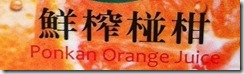
 

ponkan

Could they just as easily have left off the word orange? Yes. Might I find their packaging changed in 6 months to just say “ponkan juice?” Yes.

You remember ponkan, right? It’s 椪柑, pènggān. Who does this matter to?

You know that time in the US when you were really super excited about learning what to call your favorite Kentucky Blue Cheese McBurger sandwich with kale-infused lettuce in Chinese? And then someone was like, “oh, you mean that burger. You can just call it a 漢堡. Your fancy blah blah blah means nothing to me in my language. We barely have the stomach to let people from Kazakhstan use their proper names in Chinese. You think we’re going to let you ramble on about some fucking kind of burger?”

Things about American (North American?) English. 1: Your name counts. You don’t have to be Sally. 2: Your fruit doesn’t count. They’re all oranges. There’s no end to the marketing and classification for things. They can be Michigan cherries or Michigan red cherries or sour currants or whatever anyone cares to call them, backed up by science or not. But it's the people that make the decisions about what things are actually called.

Moving on.

More fruit. Literally.
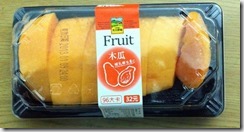
fruit

See those white Chinese characters against a red background? They say 木瓜. At least where I come from, 木瓜 usually means papaya. You're probably thinking, "they've put a picture, right? That's good enough. All fruits TOTALLY have distinctive shapes! No one ever confuses one spherical fruit with another, especially when it’s without any colors! That’s crazy!”

So, actual thing needing to be labeled, yet the result is the worse than nothing “fruit.” Again, what we have here is a nice pat on the head for 育良: look at you superstar! A totally bat-shit crazy labeling of a product you can totally see and buy has a word you fucking know and can pronounce, maybe! And it’s all fucking English! You’re the king of the world!

So, story here, again, is we have Chinese written in roman letters, for a Chinese speaking audience. Do you see a pattern? This might be getting boring for you. Sorry.

Moving on.

How about a delicious sandwich?

I know what you’re thinking: the “delicious x” is an incredibly rare structure and hard to use properly in English, so surely you’re not going to show me some packaging with that written on it that also tells me to start referring to everything as “tasty,” as well, are you?

Settle down there, cowboy. It’s just a delicious sandwich.


delicious sandwich

Doesn't it just look delicious?

The best thing about this is that along with our “fruit” example above, there’s not even a pretend attempt to inform through the use of roman letters here. We’ve abandoned all pretense to use roman letters in a way that might not cause an English speaker to sneer (remember, it’s tough to criticize single words composed of roman letters that stand alone, are fully formed and are spelled correctly.) Here, delicious sandwich cannot be read as anything except 好吃的三明治, and that’s of course why you will not find any of that written anywhere on the labeling. Sure, there’s a 土司 here and there, but that’s about it.

Why do I find this interesting? Because it’s a weird kind of thing. It’s not like pig latin, where you kind of shift things a bit to the left or look at them a little funny till they make sense. It’s not like when Ataturk made everyone stop writing in the Perso-Arabic script either. And it’s not really like India where people kind of just switched to English, or used it as a different language. Here we have a kind of consumption of the skeleton of the language: it’s sounds and writing system, and also a lot of the basic mappings of a lot of the words to certain meanings. And after chewing up all these skeleton bits, it’s wrapped around the same culture and people as the old language, with it’s old ways of saying things and writing things and meanings that make sense to them.

Delicious sandwich isn’t English. It’s Chinese, written in roman letters, pronounced according to a phonetic rule system everyone learns as a kid, based on the meanings and mappings that are common and make sense to Chinese speakers, and are foreign (and often incoherent) to places where English is spoken as a native language.This is Chinese, it’s just got a new wrapper, and a new script that looks nearly identical to English and with new sounds that sounds that are nearly identical to English, and a grammar that picks and chooses parts of English grammar to hold fast to when it wants. I think it’s wrong to call this Chinese English, which should really be reserved for something like American English or British English or Indian English. I think the term Chinglish is best applied to a compromise of an attempt to communicate across languages, something closer to a pidgin or a creole. This distinction is subtle, but “Delicious sandwich” on labeling for native English speakers is Chinglish, but on labeling for Chinese speakers, I think it’s 英式中文, or Engwen. (But since that’s kind of a fail as either Yingwen or Engwen, I guess Zhonglish is where we end up.) Some see the distinction between instrumental vs. ornamental, but I think that’s beside the point. Zhonglish is sometimes ornamental, but it doesn’t have to be. Sometimes it is instrumental and ornamental. And sometimes it is purely instrumental.

The question is, why? If you’ve got a perfectly good system to do all these things, why adopt a new one? One could argue it’s just a fashion thing: “English” today, “Hungarian” tomorrow, etc. Or one could argue it has to do with deeper power dynamics. I think you know where my vote is.

Moving on. Let’s move over to the magazine rack.

magazines

Whatcha reading guys?

Oh, the new issue of ELLL?  I LLLove that magazine! Or should I say I 心心心 that magazine?

What about you? COOKing? I fuck營 love suffixes that can be used to make gerunds too! Let’s be friends and be confused about verbs and how to translate 烹調 together!

The great thing about this shot is that everyone looks like they're reading "English," as if reading magazines in not-English is something only hooligans would do who just come into 7-11 to buy cigarettes, which IS TOTALLY NOT THE BREAD AND BUTTER OF THEIR OPERATION! DO NOT THINK THAT EVER! THEY SELL CUTE ANIMALS AND YOGURT DRINKS, NOT CANCER STICKS THAT WILL SHORTEN YOUR LIFE AND KILL YOUR RELATIVES WHILE SUCKING AWAY YOUR MONEY AND WILL TO LIVE!

Anyway, it’s the same thing going on here in the shot as in above. Just read that part over if you still don’t get it.

2013年3月10日星期日

Drugs and Sex

A lot of people wonder what happened to all the old sites of the web. It seems you almost never find something from the early days anymore. There’s a good reason for that and it’s only partly because no one links to or reads old stuff. That good reason is that most of the early web was porn. And you can’t find it because those sites are all gone. Where you can find it, however, is in books, (yes, dead-tree books) that people wrote around that time and which serve as the only decent records of what happened back then. And since I mostly talk about pop music or other silly things here, instead of what’s really dominant on the internet (porn,) think of this as a corrective to that overlooking. But first, some fun with drugs since sex and drugs seem to go together like peas and carrots.

Note: More 7-11 fun is still in store. (Pun intended)


Drugs:


drugs mean never having to say youre sorry

A happy life is a drug-free life.

Love begins at the rejection of drugs. (And judging by the location of this wall, drugs apparently start in Banqiao.)


Sex:

情色男女網路站

編著: 章道安 朱怡陶

Pornographic web sites

Editors: Zhāng Dàoān, Zhū Yítáo

p.47

Tokyo Topless

http://www.bekkoame.or.jp/~adolf/web/home.html

Last Update: Aug 28, 1996

Headlines

歡迎來到日本的熱血王牌站台,肉體橫陳,美女如排山倒海般向你撲來,高血壓及心髒病患者要預防發生意外。血壓方剛的青年,更不要忘了先拿棉花把鼻孔塞好,以免到時候...。

Welcome to Japan's hottest web site. Here you'll find enough skin and beauties at your service to kill a small horse. However, friend, beware: this page is not for the faint of heart. Those with high blood pressure or heart disease should take the necessary precautions to ensure their personal safety. For those of you just reaching manhood, don't forget to stick some tissues up your nose. It can help to avoid problems that may arise in the near future, if you catch my drift.

---

And because we cover language here, here’s one of the many hidden treasures from this book:

p.140

性愛英語

大公開

任何一種語言最難精通的部份就是俚語了,但是往往在學會以後便成為您日常生活中最常用、也是最有用的部份。以下的每一個字彙可說是字字珠璣,絕對需要您去熟讀背誦、反覆練習,才能達到爐火純青的地步。英文是國際語言,一旦練就一身好本領,您馬上就可以在成人站台裡上山下海,有如神龍活現般的悠遊其中。在您看完了各國紅燈區旅遊資訊之後,是否有立刻出國一遊的衝動?只要帶著這套字彙,再也不會有各國美女當前,而只有能膛目結舌、不知所云的悲慘狀況發生,這時宣揚國威的重責大任就拜託您了。

Sexual Terminology in English

Everything you need to know.

The toughest part of any language is surely its slang. But it often happens that this part of the language is what you come to use more than anything else day to day. And it's this part of the language that often is the most useful. Each term below can be thought of as a precious jewel. Take time to memorize each and every one. Only through repetition and practice can you attain perfection in their usage.  English is an international language. Your mastery of its particulars are a skill you can carry with you for all your days. But, first and foremost, you can use them to swim in vast sea of adult sites to your heart's content. After reading about each country's red light district, you're probably feeling the sudden urge to pay each one a visit, right? With this trusty phrasebook at your side you won't ever be stuck with a beautiful foreign lady at your side, completely unable to communicate. Nothing less than the prestige of our nation demands that you get these words right. Good luck.

2013年2月13日星期三

2012年12月12日星期三

Taiwan and China: Two cultures separated by a common language

Huang Guanhua - 黃冠華

http://money.chinatimes.com/news/news-content.aspx?id=20121104000829

- Want to do business in China? First think about the world.

The word in recent years out of the Taiwanese media almost always seems to assume that Taiwan is going to become the so-called "springboard" for the world's large corporations to enter China. The thinking is these business want to enter China, and Taiwan is where they can come to test the waters before they do. If all goes without a hitch, they can take what they've learned in Taiwan and start talking real money in China.

I'm not sure this is particularly enlightened thinking.

My company does personnel evaluations at the end of each year. Everyone ranks all their coworkers, with no exceptions.

Our staff includes people from over ten countries. The evaluations can be completed in Mandarin or English, but the questions are the same. In addition to evaluating those around you, you also have to evaluate yourself.

The biggest reason to have self-evaluations is for people to see if their personal evaluations match up to how others perceive them. It's basically to cut down on people having wildly out-of-sync thoughts about themselves. If you know about your own weaknesses you'll be less likely to make gross errors of judgement from your ignorance.

- Chinese people think they're great, Taiwanese people think they might kinda be doing ok

With executives from Taiwan, China and the US, which two groups do you think would share the most values? I suppose most people would assume this is a silly question, one hardly worth even asking. Of course, Chinese and Taiwanese people are going to be the most similar, right? They've got a common language and both come from the same stock. Americans, on other hand, have a completely different culture, foreign to both China and Taiwan.

Well, this didn't exactly turn out to be the case.

The Americans, (and most of the other staff who weren't from China or Taiwan) who operate in a culture that is constantly stressing self-confidence, predictably rated themselves extremely well in their evaluations. They were similarly confident they made important contributions to the business. If we were to use grades, nearly all of them gave themselves A's. Translating this to bonuses, they clearly expected nothing but the most generous packages.

The Taiwanese, on the other hand, were nothing if not your typical Taiwanese: traditional, humble, and low-key. Most gave themselves a B or a B+. Even the best managers rated themselves this way.

So what about the Chinese? Owing to their gigantic market and rabid competition, the Chinese managers ended up with the same levels of confidence as the Americans. Every single one gave themselves an A or an A+.

- Fight 'em in the streets, fight 'em in the jungle

So at their core, the Americans and Chinese turned out to be the most alike. It was as if the Taiwanese were from a completely foreign culture with its own distinct ways of thinking and acting.

With this in mind, does it make sense for anyone to use their experience in Taiwan to start to do business in China? Are Taiwan's potatoes simply too small to be relevant for the giant markets of China and the US? In China and the US, you've got classic guerilla warfare. The competition between businesses is just as fierce as it is between people looking for work. People are spread out everywhere and the battlelines stretch on for miles. Strategy, tactics and positioning are all like nothing we have in Taiwan. The keys to success in this kind of fighting are your ability to adapt appropriately and think about the bigger picture.

Taiwan, on the other hand, is basically a niche market. Instead of fighting it out in the jungles, we're throwing punches in the streets. We're like a cop movie where you know the crime is going to be solved by the end of the film. Every quick turn, attack or block assumes an enormous weight as it might prove crucial to how the story ends. As a business In Taiwan, you might be sitting pretty in Taipei and be able to earn a pretty penny that way. But everyone knows once you leave the city limits you must as well be facing a different planet. In comparison, you have the situation multiplied by a million in China. There you have to think about every city and every province. You've got to think about the different regions and everything else in between.

- Original recipe vs. catering to the locals

I know you're thinking, "What about all those businesspeople from Taiwan who already went to China and were successful?" If we look hard at the big and successful business in China run by Taiwanese businesspeople, like Want Want and Ting Hsin, we see that they don't resemble anything we have in Taiwan. Calling these Taiwanese businesses means nothing more than the owners were born in Taiwan or that some of the senior and technical staff come from Taiwan.

The idea of replicating a successful business experience from Taiwan in China is just something I've never seen or heard of. Keep in mind that this applies mostly to operations and strategy. With their dedication and professionalism, Taiwanese people are sure to be your greatest asset, wherever they are. That's what you should keep in mind, not the idea of simple and clean replication.

- Island culture and Continentalism

So, what have we learned? Success in Taiwan in no way guarantees easy success in China. I can think of almost nothing but examples of people who tried to copy what they did in Taiwan in China and failed. Horribly.

After decades of separation, a common language and common past doesn't mean much. We just don't think the same way anymore. We've got that much-discussed "island culture," round here and they just don't have it there.

For us, the way we think about China needs to be the way we think about the US. But, of course, that will require a certain amout of rebooting as well. We still have tons of Taiwanese people who go to America and treat it like a magical land where they're barely fit to shine people's shoes. And when they step foot in China they feel ten feet tall. They set up shop in China in their own little insular communities and barely speak a word to anyone else, whether it be in their business or personal lives. If we see more failures over there don't say I never said how to stop it.

2012年11月3日星期六

Unrecoverable Partitions?

The name Shih Tzu comes from the Chinese word for "lion" because this kind of dog was bred to resemble "the lion as depicted in traditional oriental art,"[1] such as the Chinese guardian lions. (There is also the Pekingese breed, called "lion dog" in Chinese). "Shih Tzu" is the Wade-Giles romanization the Chinese characters 獅子, meaning lion; Wade-Giles romanization was in use when the breed was first introduced in America, but in modern times Pinyin romanization is used, rendering it shīzi. The Mandarin Chinese pronunciation is approximately shirr-tsə. The Shih Tzu is also known as the "Xi Shi dog" (西施犬) because Xi Shi was regarded as one of the most beautiful women of ancient China.[2] Shih Tzus were nicknamed the Chrysanthemum Dog in England in the 1930s.[3] The dog may also be called the Tibetan Lion Dog, but whether or not the breed should be referred to as a "Tibetan" or "Chinese" breed is a source of argument, the absolute answer to which "may never be known".[4]

http://en.wikipedia.org/wiki/Shih_Tzu

- - -

其实粤语发音中“文”也是以“m”为声母的,而不是“w”。
音译的东西其实怎么好听怎么来
像外国人起中国名字也是只取其谐音即可,重要的是找个中国姓并富有含义,如汤若望(John Adam Schall von Bell)、南怀仁(Ferdinandus Verbiest)等
早期传入中国的外国词,都往往比较东方化(或中国化),像“美国”、“英国”、“德国”、法国等,后来外国的东西多了,像马达加斯加、马来西亚、马耳他、马其顿等不能都叫“马国”吧,所以音译的就多了。
但至于为什么偏要翻译成“明治”、不翻译成“明智”、“明志”或“三威治”等,是否和当初翻译的人崇拜“明治维新”有关有待考证。
不过话说回来,普通话音译的那些地名、人名确实很不怎么样。

http://tieba.baidu.com/p/199363895

確實很不怎麼樣

I think length is a crucial element as well. Coffee?

Guess I’ll leave en.wikipedia.org/wiki/Kung_fu_(term) for another day.